
If you've spent any time online this year, you've seen it. "The lore behind my morning coffee." "Adding this to my lore." "Okay, but what's the lore here?"
It turns out it wasn't just your feed. Social media management platform Sprout Social named lore its 2026 social media word of the year, after it racked up more than 10 million mentions across public posts. Their read on it: people are moving away from surface-level content and looking for deeper story and context.
That's not just an internet in-joke. It signals what audiences want from the people and businesses they follow. And if you create content for your business, it's worth paying attention to.
So what is lore?
The word comes from fandoms. Lore is all the background that makes a fictional world feel real: the history, the rules, the inside jokes, the small details fans love to piece together. You don't learn it all at once. You collect it over time, and the more you know, the more you feel part of it.
Online, the meaning has stretched. Your "lore" is now the collection of stories, habits, quirks and references that make you you. The café you always go to. The opinion you never stop banging on about. The running joke your followers are in on.
Why now?
Part of it is fatigue. Feeds are full of content that looks and sounds the same, much of it now made with AI. At SXSW London in June, one opening talk argued that the feed rewards patterns rather than stories, which is why so much of it blurs together, and that the creators doing well now are building worlds, not just telling stories.
When everything looks the same, people go looking for something with depth. Something they can get to know over time. That's lore.
Is storytelling dead?
You'll see some bold headlines saying so. German marketing magazine W&V, for example, ran a piece arguing that storytelling alone isn't enough anymore, and that the future belongs to lore.
I'd put it differently. Storytelling isn't dead. It grew up.
A story is a single moment: a post, a campaign, a launch. Lore is what builds up when those stories connect over time. One way to see the difference is that storytelling tends to be temporary and tied to a campaign, while lore keeps adding up and evolving.
You still need stories. Lore is made of them. But one great story won't keep people around. A world they can keep coming back to will.
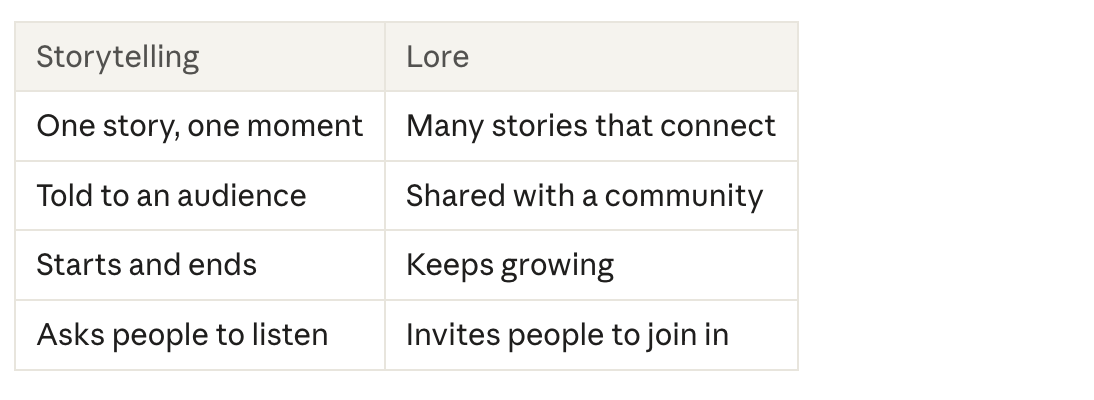
The difference between Storytelling and Lore
How to build lore into your business content
You don't need a fantasy universe or a viral moment. You need a few things people can recognise, return to and feel part of.
1. Know your origin story
Why does your business exist? Not the polished version for an "About" page, but the real moment it started. Tell it once properly, then refer back to it often.
2. Pick the ideas you'll keep coming back to
Lore is built on repetition. Choose two or three beliefs you hold strongly about your industry, and return to them again and again from different angles. Over time, people start to associate those ideas with you.
3. Create your own language
The phrases you use, the names you give your methods, the in-jokes with your audience. When followers start using your words back to you, you're building lore.
4. Start a ritual or series
A weekly post, a recurring format, a monthly behind-the-scenes. Sprout Social's research found that 57% of social users want original, multi-part series from brands, the kind that work like a TV show. A series gives people a reason to come back.
5. Leave room for people to join in
The best lore isn't just told. It's shared. Ask questions, feature your customers' stories, and build on what your audience brings to you. One way of putting it: branding asks people to recognise you, while lore invites them to help tell the story.
6. Let small details pile up
The café, the dog under your desk, the playlist you work to. On their own they're nothing. Together, over months, they make your world feel lived-in.
"Lore" is having a moment, and moments pass. Don't build your content around the buzzword. Build it around the idea underneath: depth, consistency and a world people want to be part of. That will still work long after everyone's moved on to the next word of the year.
And lore has to be true. You can't invent a backstory or fake a community. People can tell, and it breaks the trust you're trying to build.
Start building your world
You already have lore. It's in your stories, your opinions and the details you've never thought to share. The work is noticing it, and then showing up with it consistently enough that people start to feel at home.
Not sure where to start? The free Creator & Founder Storybank will help you find the stories your world is built on →